
Skin Cancers For Massage Therapists
You see more skin in one week than most people see in a year. Backs, shoulders, necks, scalps, feet, hands, and the spots clients never check themselves. That puts you in a rare position. Not to diagnose, not to name a lesion, but to notice something new, changing, or unusual, and to say it kindly and clearly enough that the client actually follows up.
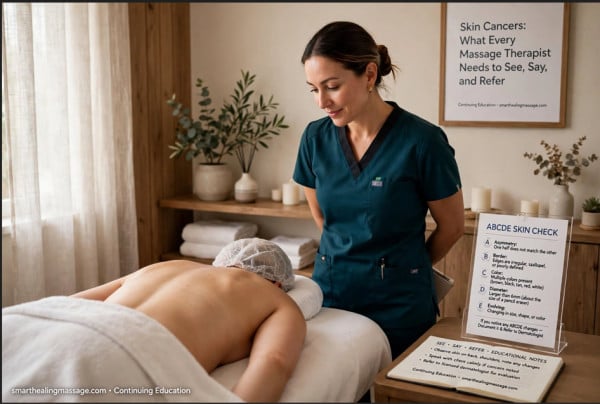
This 1 hour course is built for that moment. It is written for licensed massage therapists who want to work inside scope, protect clients, and feel confident instead of awkward when skin raises a question.
Course at a glance
- Length: 60 minutes, self paced
- Audience: Licensed massage therapists, bodyworkers, and students in clinical practice
- Format: Reading plus short reflection, 3 practice cases, and a 10 question quiz
- Site for review: smarthealingmassage.com
- Core rule: Observe, document what you see in plain language, adjust the session, and refer. You do not diagnose skin cancer.
What you will be able to do after this course
- Name the 3 common types: Describe basal cell carcinoma, squamous cell carcinoma, and melanoma in plain language, and why melanoma needs faster follow up.
- Use ABCDE plus 2 extra checks: Apply ABCDE, the ugly duckling sign, and EFG for fast growing nodules.
- Spot the places clients miss: Know where to look during a normal session, including feet, palms, scalp, behind ears, and nails.
- Talk about it without panic: Use a short, respectful script that informs without diagnosing or alarming.
- Document and refer well: Write a factual note, decide when to avoid an area, and suggest timely dermatology care.
Module 1: Why this is your work, 10 minutes
Skin cancer is a disease in which cells in the skin grow out of control. Too much exposure to ultraviolet (UV) rays from the sun or tanning beds causes most skin cancers. That damage builds over time, which is why a client can have a normal looking back for years and then develop a spot that does not heal.
You are not expected to catch every lesion. You are expected to be the second set of eyes. A client lies face down and cannot see their own upper back. A client with long hair may not see their scalp. A client who is older, works outdoors, or has fair skin and many moles may have more risk, but skin cancer affects people of all colors. For people of color, skin cancer is often diagnosed later, when it is harder to treat.
Think of this as part of intake and safety, like checking for a recent injury or a fever. It is not an add on. It is part of good care.
Pause and reflect: Think of one client whose back or feet you see every visit. What would you do differently if you noticed a new spot there next time?
Module 2: The 3 cancers to know, 15 minutes
The three most common types of skin cancer are squamous cell carcinoma, which begins in the upper layer of the skin, basal cell carcinoma, which begins in the lower layer, and melanoma, which begins in the melanocytes. Melanocytes are the cells that make melanin, the pigment that gives skin its color.
- Basal cell carcinoma, BCC: This is the most common form of skin cancer. In the United States alone, an estimated 3.6 million BCC cases are diagnosed each year. BCCs can look like open sores, red patches, pink growths, shiny bumps, scars or growths with slightly elevated, rolled edges and a central indentation. At times they may ooze, crust, itch or bleed. They grow slowly, most are curable when caught early, and they rarely spread beyond the original site. Left alone, they can grow wide and deep and destroy skin, tissue and bone.
- Squamous cell carcinoma, SCC: This begins in the thin, flat cells that form the top layer of skin. It often appears on sun exposed areas like face, ears, neck, lips, and backs of hands. It can look like a rough, scaly patch, a wart like growth, or a sore that does not heal. It grows faster than BCC and needs prompt referral.
- Melanoma: This is the third most common type, and it causes more deaths than other types because it often spreads to other parts of the body, including vital organs like the brain and liver. Early melanoma can be small and easy to miss. Late melanoma can be hard to treat. That gap is why your referral timing matters.
Basal and squamous cell carcinomas are the two most common types, and both can usually be cured, but treatment can leave scars. Do not let the word curable make you relaxed. A slow growing BCC on a nose or ear can still cause real harm if the client waits a year.
Module 3: What you actually see on the table, 15 minutes
Use ABCDE for a single spot
These definitions come from the American Academy of Dermatology, as quoted in current guidance. Use them as a prompt to look closer, not as a diagnosis.
- A is for Asymmetry: One half of the spot is unlike the other half.
- B is for Border: The spot has an irregular, scalloped, or poorly defined border.
- C is for Color: The spot has varying colors from one area to the next, such as shades of tan, brown or black, or areas of white, red, or blue.
- D is for Diameter: While melanomas are usually greater than 6 millimeters, or about the size of a pencil eraser, when diagnosed, they can be smaller.
- E is for Evolving: The spot looks different from the rest or is changing in size, shape, or color.
A useful caution: D describes size at the time melanomas are usually caught, not a safe cutoff. A small spot can still matter if it is new, changing, itching, bleeding, or just different.
Add the ugly duckling sign
Most moles on one person look broadly like each other. If any mole stands out or looks different from surrounding moles, it is the ugly duckling, the odd mole out. This helps when a client has dozens of moles and ABCDE alone feels overwhelming. Scan for the one that does not match the pattern.
Add EFG for fast growing nodules
Nodular melanoma can slip past ABCDE because it is often symmetrical, evenly colored, and regular bordered. It is also fast growing. The additional signs are elevated, firm, and growing. A raised, firm lump that has appeared or changed over the past few weeks deserves attention even if it looks unremarkable by ABCDE.
Where to look, and where skin of color needs extra attention
In a normal session, you already see the high yield areas: scalp and hairline, neck, shoulders, upper back, behind ears, arms, and lower legs. Add feet on purpose. Check soles, between toes, palms, and nails when those areas are in your session and you have consent to work there.
Skin cancer on darker skin often occurs on areas that get little sun exposure, like the palms of hands, soles of feet, under and around the nails. Check yourself monthly and get a full body skin exam at least once a year is the advice given to the public, and it is a useful line to share with clients. For Black patients, the estimated five year melanoma survival rate is 70 percent, versus 94 percent for white patients, a gap driven in large part by later diagnosis. Your attention to feet and nails can help close that gap.
Practice cases
Case 1: A 58 year old client, face down, has a pink, shiny bump on the upper back with a rolled edge and a small crust in the center. It was not there at the last visit 3 months ago. Action: Do not massage directly over it, note it in plain language, tell the client at the end of the session, suggest prompt dermatology care.
Case 2: A 34 year old client has a dark streak running the length of a toenail, with pigment spreading onto the skin around the nail. She says she thought it was a bruise from running. Action: Do not dismiss it as trauma, do not try to clean it, note it, and refer promptly.
Case 3: A 71 year old client has a rough, scaly patch on the ear that bleeds when the towel touches it and never fully heals. Action: Avoid friction on that ear, use a soft drape, document bleeding and non healing, and refer this week rather than next month.
Module 4: What to say, what to write, and when not to massage, 10 minutes
A script you can use word for word
Say this after the session, with the client dressed, in a calm and private tone:
“I noticed a spot on your upper back that I have not seen before. I am not able to tell what it is, and that is outside what I do as a massage therapist. Because it is new and it looks a little different from your other spots, I think it is worth having a dermatologist look at it soon. Would you like me to write down what I saw so you can share it?”
What this script does well: It states an observation, not a diagnosis. It names the reason for concern in one sentence. It gives a clear next step. It offers a written note, which makes follow up more likely.
Avoid: “That looks like melanoma.” Avoid: “That is probably nothing.” Avoid: “You should get that cut out.” All three go beyond scope, and the middle one can delay care.
Documentation that protects the client and you
Write facts, not conclusions. Good note: “New 8 mm pink, shiny spot on left upper back, center crust, noted 10:15 am, client informed, advised to see dermatologist, area avoided during session.” Poor note: “Possible skin cancer, told client to get it removed.”
Include date, location in plain terms, size if you can estimate it, color and surface, whether it bled or is open, whether the client said it is new or changing, what you did, and that you referred.
When to adjust the session
Do not massage directly over an open sore, a bleeding spot, a crusted or oozing lesion, or a very tender new lump. Work around it, keep the drape clean and soft, and avoid lotions, oils, or heat on that spot. If the client has a large area of sunburn, blistering, or a fresh biopsy or surgical site, reschedule or work only on unaffected areas with consent and physician clearance when needed. If a client is in active treatment for skin cancer, ask for clearance and adapt pressure, positioning, and skin care.
Prevention talk you can share safely
You can share general sun safety information without prescribing a product: seek shade during peak hours, wear protective clothing and a wide brim hat, and use broad spectrum sunscreen as directed on the label. Encourage clients to check their own skin monthly and to see a dermatologist once a year, especially if they have many moles, fair skin, a history of sunburns, a family history, or a weakened immune system.
Quiz: Check your understanding, 5 minutes
1. Which type is most common? Basal cell carcinoma.
2. Which type causes the most deaths because it can spread to vital organs? Melanoma.
3. A spot is 4 mm, new, and changing. Does size alone rule out concern? No. Melanomas can be smaller than 6 mm.
4. A client has 40 similar brown moles and one pink, raised mole that looks different. What sign is that? Ugly duckling.
5. A raised, firm lump appeared 3 weeks ago and is growing. What extra check applies? EFG: elevated, firm, growing.
6. Where is melanoma most likely to appear on darker skin? Palms, soles, under and around nails, and other low sun areas.
7. A client has an open sore on the shoulder that has not healed in 6 weeks. What do you do? Avoid the area, document facts, refer promptly.
8. Which phrase stays in scope? “I noticed a new spot that looks different from your others, and I suggest a dermatologist look at it soon.”
9. Should you massage over a bleeding, crusted lesion to “help circulation”? No. Avoid it and refer.
10. What is your role? Observe, document, adjust, refer. Not diagnose.
FAQ
Can I diagnose skin cancer if I am sure? No. Diagnosis needs a clinician, often with a biopsy and pathology. Your training and license do not include diagnosis, and a confident label can harm the client if it is wrong in either direction.
What if the client gets upset or embarrassed? Stay steady. Say you mention it because you care about their health and because early follow up makes treatment simpler. Offer the written note and let them decide. Do not push or repeat the warning during the session.
Should I tell a client if I see something in a private area? Only if that area is already within the scope of your consented session and draping. Do not undrape to check. If you happen to see something while working in a consented area, mention it privately and factually after the session.
What if I am wrong and it is nothing? That is a good outcome. A prompt dermatology visit that ends with reassurance is not a false alarm. It is the system working.
Does massage spread skin cancer? There is no evidence that gentle massage spreads a local skin cancer, but you should not massage directly over a suspicious, open, or inflamed lesion, and you should follow physician guidance for clients in active treatment.
Can I recommend a specific sunscreen or treatment? Do not prescribe a product or treatment for a skin condition. You can share general sun protection information and encourage the client to ask their dermatologist or pharmacist about what fits their skin.
How do I bring this up with a long term client without damaging trust? Frame it as part of your routine: “I check skin as part of safety, like I check for injuries. I noticed something new and wanted you to know.” Most clients thank you.
What if the client says they already know about it? Ask if they have had it checked recently and if it has changed since. Document their answer and still avoid the area if it is open or irritated.
References and further reading
Use these for your own review and for links on smarthealingmassage.com. The course text above is original, written for massage therapists, and the facts are drawn from these sources.
- Centers for Disease Control and Prevention. Skin Cancer Basics. What skin cancer is, the three common types, and UV as the main cause.
- Skin Cancer Foundation. Basal Cell Carcinoma Overview. How common BCC is, what it can look like, and why early treatment matters.
- Skin Cancer Foundation. Skin Cancer in Skin of Color. Why diagnosis is often later, where to look, and survival differences by group.
- American Academy of Dermatology. ABCDEs of Melanoma, as quoted in current warning signs guidance. Asymmetry, border, color, diameter, and evolving, plus the ugly duckling and EFG checks.
This course is educational and does not replace medical evaluation, and that massage therapists should follow their state scope of practice and employer policies for referral and documentation.
